Standup and changelog
Standup summary
st standup                 # last 24 hours (default)
st standup --hours 48      # look back further
st standup --all           # include all stacks
st standup --json          # raw activity as JSON
st standup --ci            # also check CI for selected branches
st standup --ci --json     # CI results plus machine-readable signal states
Human-readable standup output shows progress while stax collects Git/forge/Jira context. Use --json for machine-readable output without progress lines.
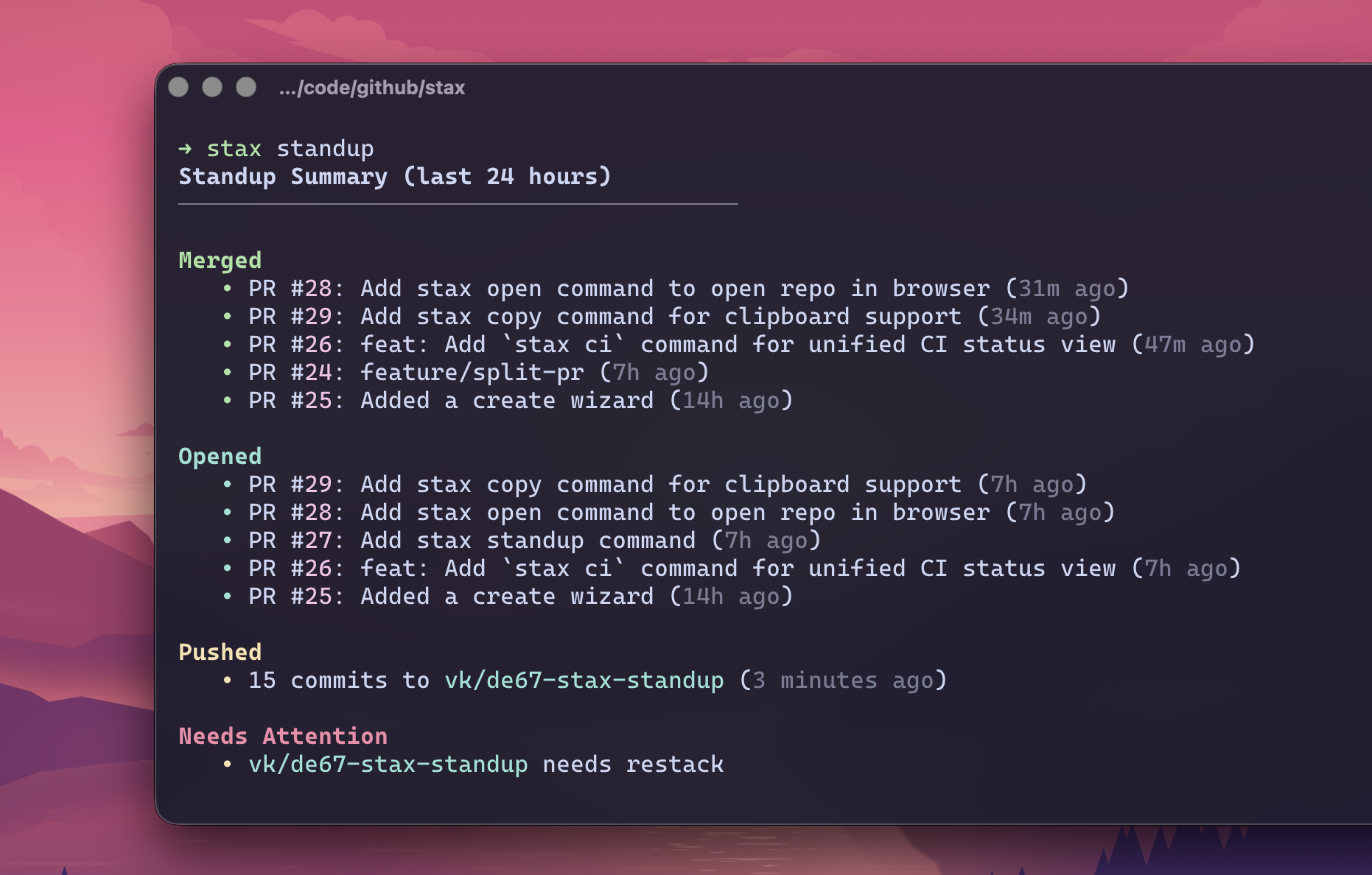
Shows merged PRs, opened PRs, recent pushes, authored reviews, and items needing attention. Works with GitHub, GitLab, and Gitea.
GitHub authored reviews use one time-bounded GraphQL request capped at 100 results, followed by local repository and time filtering. GitLab and Gitea report this signal as unsupported; stax does not scan every merge or pull request. API and authentication failures are reported as unavailable instead of being presented as a successful empty result.
CI is deliberately off by default, so ordinary standup collection adds no per-branch CI latency. Pass --ci to check only the selected current-stack branches with bounded concurrency. --all --ci intentionally widens that scope to all tracked branches.
JSON keeps the compatibility arrays reviews_given and needs_attention.ci_failing. Read the companion signals.reviews_given and signals.ci_failing entries before interpreting an empty array: statuses are available, unsupported, unavailable, or not_requested, with a reason when useful.
AI standup summary
Generate a concise spoken-style summary using your configured AI agent:
st standup --ai
st standup --ai --hours 48
st standup --ai --agent claude
st standup --ai --style slack  # Slack-ready Yesterday/Today bullets
st standup --ai --jit       # add Jira context via jit
Uses the agent configured under [ai] in ~/.config/stax/config.toml (same agent as st gen / st generate --pr-body). Override per-run with --agent.
With --jit, standup inspects your current Jira sprint via the jit CLI and feeds the AI two extra signals:
- tickets with PRs already in flight
- likely next backlog tickets without PRs
The summary is word-wrapped into a card fit to your terminal width:
  ✓ Generating standup summary with codex        4.1s

  ╭──────────────────────────────────────────────────────────────────╮
  │                                                                  │
  │  Yesterday I finished the billing webhook retry fix and split    │
  │  the reporting dashboard cleanup into two PRs so review stays    │
  │  small. I also opened a third PR to speed up integration tests   │
  │  by caching seed data, and all three are now in review. Today    │
  │  I'm handling review feedback and preparing the next analytics   │
  │  task.                                                           │
  │                                                                  │
  ╰──────────────────────────────────────────────────────────────────╯
Key phrases are highlighted: completed work in green, new work in cyan, reviews in blue, upcoming tasks in yellow.
For a copy-ready Slack update, use the Slack style:
st standup --ai --style slack
It prints plain text with the same shape as a team standup thread, carrying unfinished branch, PR, or Jira work into Today when the activity shows something is still in flight:
Yesterday:
• finished the billing webhook retry fix
• opened the reporting dashboard cleanup for review

Today:
• handle review feedback
• prepare the next analytics task
Output formats
st standup --ai               # spinner + colored card (default)
st standup --ai --style slack # Slack-ready Yesterday/Today bullets
st standup --ai --plain-text  # raw text, pipe-friendly
st standup --ai --json        # {"summary": "..."}
Progress feedback is shown for the default card and Slack styles while context collection and AI generation run. Use --ai --plain-text or --ai --json when stdout must contain only the generated summary.
Prerequisites
- An AI agent installed on
PATH:claude,codex,gemini,opencode,pi, orhermes - For
--jit:jitonPATH - Agent configured in
~/.config/stax/config.toml:
[ai]
agent = "claude"   # or "codex", "gemini", "opencode", "pi", "hermes"
Or pass --agent directly.
Changelog generation
st changelog                   # auto-detect last tag → HEAD
st changelog v1.0.0            # explicit from ref → HEAD
st changelog v1.0.0 v2.0.0     # between two refs
st changelog abc123 def456     # between two commits
st changelog find              # fuzzy-find commits interactively
st changelog find "auth fix"   # fuzzy-find commits in the default range
st changelog --find "auth fix" # flag form for scripts
PR numbers are extracted from squash-merge commit messages like (#123).
find / --find searches commit messages in the same range used by st changelog.
Use positional refs with the flag form, for example st changelog v1.0.0 HEAD --find "auth fix".
Add --json with a query for scriptable output.
Monorepo tag prefix
With platform-scoped tags like release/ios/v1.2.0, pick the latest tag matching a prefix:
st changelog --tag-prefix release/ios
st changelog --tag-prefix release/android --json
Path filtering
st changelog v1.0.0 --path apps/frontend
st changelog v1.0.0 --path packages/shared-utils
st changelog find "auth fix" --path apps/frontend
JSON output
st changelog v1.0.0 --json
st changelog --json              # auto-resolved tag appears in "resolved_from"